
The constitution of a human being (Summary)
by Atman Nityananda
Man is a multidimensional being and has two distinct natures.
- One is the apparent self which consists of the body, vital energy (prana), mind (has four aspects, see below) and causal body and has as a central factor the ego.
- The other one is the true Self, (Consciousness, Soul) which is eternal, immortal unchangeable, indestructible and beyond form, time and causality.
The Ego is the factor that separates man from Divine consciousness (God) and all creation. Ego is the factor that makes us identify with body, mind and sensory impressions, veils our true nature preventing us from being aware of It and makes us suffer. Although our true identity is Consciousness due to the ego we believe that we are the physical body; that we are a limited body-mind entity, separate from life and God.
The three qualities or Gunas of mind
(Sattva, Rajas, Tamas)
- Sattva — equilibrium and serenity
- Rajas — dynamism and movement
- Tamas — inertia and stagnancy
Constitution of a Human Being
1. Consciousness – True Self
2. Causal body
3. Mind the inner quadruple organ (mind has four aspects: 1. the external mind (Manas), 2.the intermediate mind 1, 3. the inner mind (Chitta) and 4. the ego (Ahamkara).
4. The Vital Energy (Prana).
5. The three subtle energies:
6. Sexual Energy
7. The Physical Body. Bioenergies
1. Consciousness – True Self
Being or Existence – Consciousness or awareness -Bliss (Satchitananda)
Our true Self, what we really are, is Pure Consciousness and it is identical with the Absolute or Universal Consciousness* which is the highest principle of the universe (what we call God, Brahman, etc.).
Our true Self (Consciousness) is experienced in us as the timeless, formless, immovable, unchanging, ever-present, silent presence, and as peace, plenitude, freedom and bliss.
2. The causal body
The Causal body is constitud only by the Anandamaya Kosha, the sheath of bliss or happiness
Mind the inner quadruple organ
The four aspects of mind
1. Inner mind (Chitta)
2. Intermediate mind (Budhhi)
3. External mind (Manas)
4. Ego (Ahamkara).
1. The inner mind (Chitta)
The subconscious mind, memory, conditioned consciousness, total field of mind
2. The intermediate mind (Buddhi).
It has two aspects:
1. Lower intellect and
2. Higher intellect (intelligence )
The higher aspect of the intermediate mind (intelligence) decides, knows, reasons, discerns in a high level the true from the false. We can know intuitively our true Self (Consciousness) and discern it from the ego, mind and body.
The lower aspect of intermediate mind (Intellect), because it is affected and distorted by the ego and its tendencies (lust, lasciviousness, fear, anger, envy, jealousy, greed, avarice, pride, etc.), functions in a limited and distorted way. Divides, separates, classifies, labels and functions as a servant of the lower ego to fulfil his egocentric desires.
3. The external mind (Manas)
Outer mind (Manas): The external mind, or manas, is the seat of emotions, thoughts, and sensory perceptions. It interprets the information received from the external world and processes it (along with the inner mind, chitta), influencing our feelings, desires, and responses.
Aspects of the external mind:
· Sensory mind
· Emotional mind
· Thinking mind
· Motor mind
4. Ego (Ahamkara), our illusory self
The ego identified with the bodies is the apparent self
The ego has two main aspects:
The higher sáttvic ego
The lower rajasotamasic ego
4. Vital energy (Prana)
1. Psychic prana. It gives the energy for the psychological functions and processes.
2. Physical prana. It gives the energy for the physiological functions and processes.
Division of Prana in five main pranas and 5 subpranas
5 Pranas – (apana, vyana, udana, samana, vyana)
5 Subpranas (Naga, Kurma, Krikara, Devadatta, Dhananjaya). The physical vital enable all functions of the body.
Energy Channels – Nadis
The prana flows through the 72.000 nadis (channels)
Energy centers or Chakras
There are also many energy centers (chakras),
The 7 main centers are located along the spinal column.
5. The three subtle energies
The three subtle energies are:
Ojas,
Tejas
Higher Prana
6. Sexual energy.
The reproductive energy. Gives birth to new life.
It is related to physical and psychological health and
is also fundamental for our spiritual transformation and divinization.
7. Physical body.
1. The three humours or bio-energies (Doshas: Vata, Pitta and Kapha)
2. The Physical structure with all all organs and systems (Nervous, Digestive, etc.)
3. Five senses and five organs of action:
5 senses of cognition (eyes ears, nose, mouth, touch) and
5 organs of action (hands, feet, genitals mouth, anus).
Human being according to Yoga and Vedanta
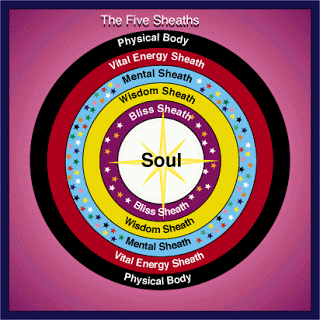
According Yoga and Vedanta a human being consists of five Sheats (Koshas) or three bodies
The five sheaths
1. Annamaya Kosha, the Food Sheath (Physical Body)
2. Pranamaya Kosha, the vital sheath (Prana-vital energy)
3. Manomaya Kosha, the mental sheath (external mind, -manas)
4. Vijñanamaya Kosha, the sheath of the intellect (the intermidiate mind, -Buddhi),
5. Anandamaya Kosha, the sheath of bliss, bliss (the causal body)
The three bodies
These five sheaths constitute the thre bodies
1. The causal body / The Anandamaya Kosha, the sheath of bliss or happiness
2. The Subtle or Astral body. It consists of the Pranamaya Kosha, the vital sheath, The Manomaya Kosha, the mental sheath (manas), The Vijñanamaya Kosha, the sheath of the intellect (Buddhi),
3. The Physical Body / The Annamaya Kosha, the Food Sheath.
 atmannityanada