
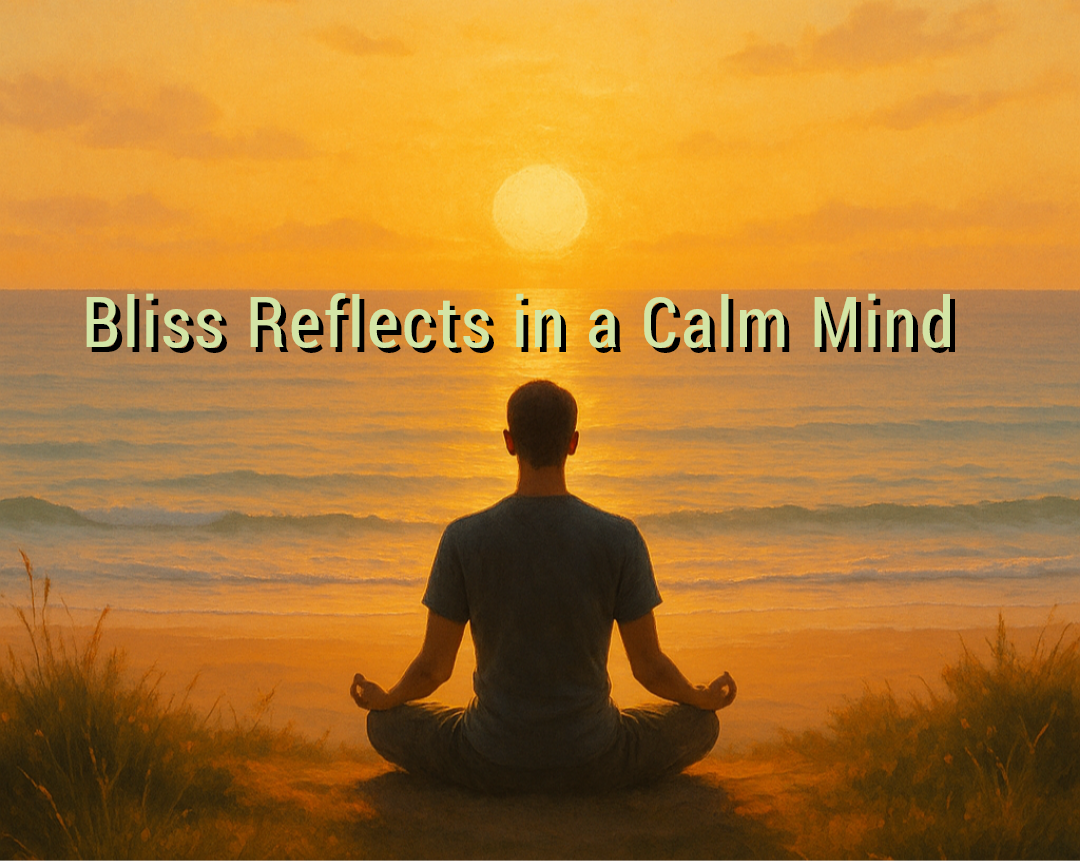
Bliss Reflects in a Calm Mind
by Atman Nityananda
“True, everlasting happiness comes from within — from our divine nature, the true Self.”
True happiness comes from the Self, which is unchanging and full of bliss, while sensory experiences—driven by the play of the guṇas—bring restlessness and suffering. The mind reflects either the joy of the sattvic nature and the bliss of the Self or the agitation caused by the ego’s reactions to the ever-changing impressions.
When desire arises due to memory or some trigger, the vital energy, emotional, and thinking mind become restless and disturbed. When the desire is fulfilled, the mind briefly calms down and assumes its sattvic state, and in that stillness, the joy of sattva is manifested and the bliss (fullness, freedom, peace) of the Self is reflected. However, due to ignorance and lack of discernment, we wrongly associate the happiness of sattva and of the Self (awareness) with the object. What really happens is that the calmness of the mind reveals the inner happiness of sattva and of the Self—the silent space of awareness.
This peace, joy, and fullness fade as soon as another desire appears and disturbs the peace. In deep sleep, where the senses and mind are at rest, bliss is naturally experienced, but we are not conscious of it. In liberation, the mind remains naturally and effortlessly calm, so the intimate happiness (peace, freedom, fullness) is constantly experienced. Thus, joy is of the sattva mode of the mind, which is a reflection of the Self’s bliss, and bliss (peace, fullness, and freedom) is of the Self itself, shining through only when the mind is quiet.
Objections and Their Resolution
Objection 1
Calmness fades due to emotions and thoughts, not just desire.
Resolution:
You’re absolutely right. Calmness fades whenever the mind is disturbed by any emotional or mental agitation, not just desire. Whether it’s fear, anxiety, anger, or overthinking, these factors all disrupt the peace. The key point remains: the happiness we experience is simply the reflection of the Self’s bliss when the mind assumes its sattvic state (calm, serene, still, diaphanous), regardless of the cause of agitation.
Objection 2
Is there a state of bliss during deep sleep if we have no memory or awareness of it?
Resolution:
In deep sleep, we don’t have direct awareness of the bliss of the Self because there’s no active mind to recognize it. However, after waking up, we often feel refreshed and at peace, which suggests that bliss was present, even if we couldn’t consciously experience it. This feeling is referential knowledge, not memory. It points to the absence of suffering and the restful state of the mind, which indirectly implies the presence of bliss.
Moreover, the liberated ones don’t lose consciousness even in deep sleep, and their experience confirms that deep sleep is experienced in the bliss of the Self.
Remember that deep meditation is conscious deep sleep—that is, we enter consciously into the state of deep sleep.
… … …
🔶 ATMAN’S SUBSTACK
”Walk the Path of Truth & Inner Freedom”
Join me for weekly teachings, videos, and community on Substack.
👉 Subscribe now and deepen your journey.
Repeat God’s name constantly
“The water to purify your heart is the name of God.” “Of utmost importance is to increase the repetition of God’s Name (japa) daily. In this way, your heart and mind will be purified, and only then will you find (realize) God within you.”
~ Haidakhan Babaji
- Liberation with the Power of Mantra – (ORDER ON AMAZON)
- DIE TO LIVE – (ORDER ON AMAZON)
- The Art of Living Non-duality Moment by Moment – In edition
The ‘secret’ to a plentiful life, a life of harmony, happiness and contentment is to have a sattvic mind free from desires and ego and to live in every moment in conscious contact with our true Self (Consciousness).
🌺 Peace, Love, Harmony
 atmannityanada