
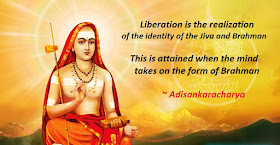
DRG DRISHYA VIVEKA
by Adisankaracharya
Translation By Swami Vidyaranya (Sringeri Mata Acharya)
NOTE : Although also attributed to Adi Shankara, the text is most commonly attributed to Bharatī Tīrtha (c. 1350). It is also known as Vakya Suddha, which is attributed to Adi Shankara.
Verse 1 : The eye is the seer, and form (and colour) the seen. That (eye) is the seen and the mind is (its) seer. The witness alone is the Seer of thoughts in the mind and never the seen.
Verse 2 : The forms are many and varied on account of differences like blue, yellow, gross, subtle, short, long, etc. The eye remaining the same sees (them) all.
Verse 3 : The mind, remaining the same, knows the different characteristics of the eye such as blindness, dullness and sharpness. This also applies in case of ears, skin etc.
Verse 4 : Consciousness remaining the same, illumines the thoughts of desire, willingness, doubt, belief, disbelief, fortitude, and its lack thereof, modesty, understanding, fear and such others.
Verse 5 : This (Consciousness) does not rise (is unborn) and does not set (is immortal). It does not increase or decay (is immutable). It shines by Itself and It illumines others without any aid.
Verse 6 : The intellect (buddhi) appears to be conscious on account of the reflection of Consciousness present in it. The intellect (buddhi) is of two kinds. One is the ego and the other is the inner instrument (mind, intellect, memory).
Verse 7 : It is considered (by the wise) that the identity of the reflection (of Consciousness) and the ego is like that of the heated iron ball. That (identified) ego (in turn) due to identification (with the body) enlivens the body.
Verse 8 : The identification of the ego with reflection of Consciousness, the body and the witness is of three kinds – natural, born of past actions and born of ignorance, respectively.
Verse 9 : The natural (identification) between the mutually related (ego and reflection of Consciousness) cannot be annihilated. But the other two (due to Karmas and due to delusion) are eliminated with the exhaustion of Karma and with direct Knowledge respectively.
Verse 10 : The body also becomes unconscious in deep sleep when the ego is in absorption. The half manifestation of the ego is dream and its full (manifestation), the waking.
Verse 11 : Dream State The thought modification of the inner equipment having attained an identity with the reflection of Consciousness in the dream state, project impressions, and in the waking state imagine objects outside with the eyes (sense organs).
Verse 12 : The one insentient subtle (body) which is constituted of mind and ego, goes through the three states, and it is born and it dies.
Verse 13 : Indeed, maya has two powers of the nature of projecting and veiling. The projecting power creates the world, beginning from the subtle body (the experiencer) to the total universe (the experienced).
Verse 14 : Creation is the manifestation of names and forms in the Reality which is Existence – Consciousness – Bliss, like foam etc. in the ocean.
Verse 15 : Avarna Shakti : The other power (veiling power of Maya) veils the distinction between the Seer and the seen within, and the Reality and the creation outside. It is the cause of Samsara.
Verse 16 : The subtle body in close proximity to the Witness and identified with the gross body, due to the influence of the reflection of Consciousness, shines and becomes the individual or the empirical embodied Self.
Verse 17 : The jivahood (finitude) of the jiva (individual) appears in the Witness also due to superimposition. But when the veiling is destroyed, the difference becomes clear and that (notion of finitude) goes away.
Verse 18 : Similarly, the veiling power covers the distinction of the creation and Reality and due to its influence, Reality appears as though undergoing modifications.
Verse 19 : In this case also by the destruction of the veil the distinction of Reality and creation becomes clear. Of the two, the modification exists in the creation, never in Reality.
Verse 20 : Important verse Every entity has five aspects – it is, it shines, it is dear, its name, and its form. The first three belong to Reality and the latter two to the world.
Verse 21 : Existence-Consciousness-Bliss is the same in space, air, fire, water and earth, and in deities, animals, man, and so on. Only their names and forms differ.
Verse 22 : Being indifferent to both name and form, and devoted to the Truth, one should always practise meditation both in the heart and outside.
Verse 23 : The practice of meditation within is of two kinds: with duality and without duality. Meditation with duality is again of two kinds, that which is associated with the seen and with words.
Verse 24 : Thoughts arising in the mind like desires, etc. are the seen. One should meditate on Consciousness as their witness. This is the meditation with duality associated with the seen.
Verse 25 : I am unattached, Existence-Consciousness-Bliss self-shining, free from duality, this is the practice of meditation with duality associated with words.
Verse 26 : But, the non-dual state of meditation is like a flame in a place free from wind on account of complete absorption in the Bliss of Self-realisation, having ignored both the seen and the words.
Verse 27 : As in the heart, in any outside object also the first meditation (associated with the seen) is possible. That meditation is the separation of the name and form from pure Existence.
Verse 28 : The reality is undivided, of the same essence, of the nature of Existence – Consciousness – Bliss. Such uninterrupted contemplation is meditation of the middle kind.
Verse 29 : The total stillness within due to the experience of Bliss is the third kind of meditation as described previously. One should always spend time in the practice of these six meditations.
Verse 30 : When identification with the body disappears and the supreme Self is known, wherever the mind goes, there one experiences meditation.
Verse 31 : The knot of the heart is cut, all doubts are resolved and all his karmas get exhausted when the vision of Him, who is high and low, takes place.
Verse 32 : There are three conceptions of Jiva (Consciousness), namely, as that limited (by) Prana etc., as that presented (in the mind) and the third one Consciousness as imagined in dream (to have assumed the forms of man etc.).
Verse 33 : Limitation is illusory but that which appears to be limited is real. The Jivahood (of the Self) is due to the superimposition of the illusory attributes. But really it has the nature of Brahman.
Verse 34 : Such Vedic statements as That Thou art etc. declare the identity of partless Brahman with the Jiva who appears as such from the standpoint of the Theory of limitation. But it does not agree with the other two views (of Jiva).
Verse 35-36 : It is because the fallacious presentation of Consciousness located in the Buddhi performs various actions and enjoys their results, therefore it is called Jiva. And all this, consisting of the elements and their products which are of the nature of the objects of enjoyment, is called Jagat (universe).
Verse 37 : These two, dating from time without beginning, have (only) empirical existence and exist till one attains liberation. Therefore both are called empirical.
Verse 38 : Sleep, said to be associated with Consciousness wrongly presented (in the mind) and of the nature of concealment and projection, at first covers the (empirical) individual self and the cognized universe, but then imagines them (in dream) afresh.
Verse 39 : These two objects (namely, the perceiving self and the perceived world) are illusory on account of their having existed only during the period of (dream) experience. It is because no one after waking up from dream sees those objects when one dreams again.
Verse 40 : He who is the illusory Jiva thinks the illusory world as real but the empirical Jiva thinks (the dreaming world) as unreal.
Verse 41 : He who is the empirical Jiva sees this empirical world as real. But the real Jiva knows it to be unreal.
Verse 42 : But the Paramarthika Jiva knows its identity with Brahman to be (alone) real. He does not see the other, (if he sees the other) he knows it to be illusory.
Verse 43 & 44 : As such characteristics of water as sweetness, fluidity and coldness appear to inhere in the waves, and then also in the foams of which the waves are the substratum, so also Existence, Consciusness and Bliss which are the (natural characteristics of Sakshin) appear to inhere in the Vyavaharika Jiva on account of its relation (with Sakshin) and through it similarly inhere in the Pratibhasika Jiva.
Verse 45 : With the disappearance of the foam (in the wave), its characteristics such as fluidity etc. merge in the wave; again with the disappearance of the wave in the water, these characteristics merge, as before, in the water.
Verse 46 : With the disappearance of the Pratibhasika Jiva (in the Vyavaharika Jiva) Existence, Consciousness and Bliss (which are its characteristics) merge in the Vyavaharika Jiva. When that also disappears (in Sakshin) these characteristics (finally) merge in Sakshin.
Source: https://vedantastudents.com/wp-content/uploads/2020/07/Drg-Drsya-Viveka-Class-notes.pdf
The ‘secret’ to a plentiful life, a life of harmony, happiness and contentment is to have a sattvic mind free from desires and ego and to live in every moment in conscious contact with our true Self (Consciousness).
🌺 Peace, Love, Harmony
 atmannityanada