
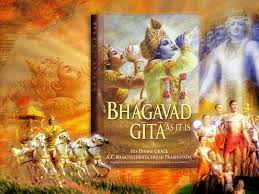
The man of steady wisdom
– Bhagavad Gita Chapter II
— Arjuna said:
- O Keshava, how do you define the man of steady wisdom, established in samadhi? How does the man of steady wisdom speak, how does he walk, how does he sit?
— The Blessed Lord said:
- O Partha, he who renounces all desires and is satisfied in his own Self is considered a man of steady wisdom.
- He who remains unshaken in adversity and does not long for happiness, who has no attachment, fear, or anger, is a muni of steady wisdom. (Muni means: a wise one who remains silent.)
- The wisdom of one who remains unattached in all situations is steady; he does not rejoice in good fortune or feel troubled by misfortune.
- And when he completely withdraws the senses from their respective objects, like a tortoise hiding its limbs in its shell, then his knowledge becomes solidified.
- The objects detach from the abstinent person, but the desire for enjoyment does not. He who realizes the Supreme Being is free from even this desire.
- O Kounteya, the turbulent senses forcibly carry away the mind of one who is striving for perfection.
- Controlling them, the man of steady wisdom should meditate on Me. Certainly, the wisdom of one who has controlled his senses does not waver.
62-63. In the one who thinks of the objects, attachment arises; from attachment, desire is born; from unfulfilled desire arises anger; from anger comes delusion; from delusion, the confusion of memory; then the will is destroyed, and the man perishes.
- But the controlled man, with his senses restrained and free from attraction and aversion, though he moves among the objects, attains peace.
- Upon attaining peace, all his sorrows disappear. Indeed, the wisdom of the tranquil man is firmly established very quickly.
- Conversely, for the uncontrolled, there is neither wisdom nor meditation. He who does not meditate has no peace; and without peace, how can happiness be attained?
- Just as the wind carries a boat off course, so too does one lose consciousness when the mind is led by the restless senses.
- Therefore, O you of mighty arms, he whose senses are well controlled in relation to the objects has attained steady knowledge.
- What is night for common beings is day for the self-controlled man; and what is day for them is night for the knower of the Self.
(The ordinary man is ignorant of supreme knowledge, which is attained by the self-controlled man. The consciousness of the ordinary man, which is always restless, is purely sensory; the wise man is indifferent to that kind of consciousness.) - Only the muni (silent sage, or one who always thinks of God) attains peace, in whom desires enter just as rivers enter the full and placid ocean, without disturbing it, and not one who desires pleasures.
- He who lives unattached, who abandons all desires, and who has no notion of “I” or “mine,” attains peace.
- O Partha, this is the state of being established in Brahman; having attained this, there are no more illusions. Even when one attains this state at the time of death, the man reaches Brahma-Nirvana and identifies with the Supreme.
Hari Om Tat Sat
The ‘secret’ to a plentiful life, a life of harmony, happiness and contentment is to have a sattvic mind free from desires and ego and to live in every moment in conscious contact with our true Self (Consciousness).
🌺 Peace, Love, Harmony
 atmannityanada