
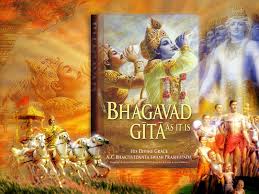
These are 42 selected verses from the Bhagavad Gita, rearranged by Sri Ramana Maharshi, intending to capture the song’s essence in one reading:
- Seeing Arjuna full of compassion and very sorrowful, his eyes brimming with tears, Madhusudana (God or Vishnu), Krsna, spoke the following words.. [ii:1]
- This body, O Son of Kunti [Arjuna], is known as the field; and he who is aware of it is called the Knower of the Field by the wise. [xiii:2]
- And know that I am the Knower of the Field in all the fields, O Bharata (conqueror of enemies). The knowledge of the Field and the Knower of that, in my opinion, is true knowledge. [xiii:3]
- I am the Self, O Gudakesa (conqueror of ignorance), dwelling in the Hearts of all beings. I am the beginning and the middle and the end of all beings. [x:20]
- For to him who is born death is indeed certain, and to him who dies birth is certain. Therefore you should not grieve for the inevitable. [ii:27]
- That is not born, nor does It ever die; nor, having been, does It ever cease to be. That Unborn, Eternal, abiding, primeval Being is not slain when the body is slain. [ii:20]
- Invulnerable He is, not to be burnt, not to be drenched or dried. He is Eternal, all-pervading, changeless, motionless, enduring. [ii:24]
- Know that which pervades the entire body is indestructible. No one is able to destroy the imperishable soul. [ii:17]
- The unreal has no being, the Real no non-being. These two facts the Truth-seers perceive. [ii:16]
- Just as the all-pervading ether, being subtle, is not affected, [tainted or contaminated by anything], even so, the Self, pervading the whole body, is not tainted. [xiii:33]
- Neither sun, nor moon, nor fire illumine this state on attaining which one does not return. And this is My Supreme abode. [xv:6]
- This Supreme state is called the Unmanifest Imperishable [Avyakto Akshara]. That is My highest abode. For those who attain to It, there is no return [to this cycle of births and deaths]. [viii:21]
- The undeluded, those who are free from pride and ignorance, who have overcome the evil of attachment, who are ever devoted to the Self, who have turned away from desires and are entirely beyond the dualities of pleasure and pain, attain that Imperishable state. [xv:5]
- He who abandons the injunctions of the scriptures and behaves according to the impulses of his desires, attains neither Perfection, nor happiness, nor the Highest state of salvation. [xvi:23]
- He who sees the Supreme Lord, residing equally in all beings – the Imperishable One among the perishables – sees [truly]. [xiii:28]
- Only by unswerving devotion can I be known and truly seen in this form, Arjuna, and even be entered into, O Bharata. [xi:54]
- The faith of everyone is according to his nature, O Bharata. Man is essentially endowed with faith. What his faith is, that indeed is he. [xvii:3]
- One who has faith and concentration and has subdued his senses attains [true] knowledge. Having gained knowledge he speedily attains Supreme peace. [iv:39]
- To them ever steadfast in loving worship, I give the Yoga of understanding by which they attain to Me. [x:10]
- Out of compassion for them, I, dwelling in their Heart, destroy the darkness born of ignorance with the effulgent light of knowledge. [x:11]
- But in those whose unwisdom is destroyed by wisdom, that wisdom like the sun, reveals the Supreme [Param]. [v:16]
- Mighty, they say, are the senses, mightier than these, the mind, mightier than that the intellect, but mightier still is He (the imperishable soul). [iii:42]
- Thus knowing Him who is beyond the intellect, O mighty in arms, control your self by the Self and slay the enemy in the form of desire, hard though it may be. [iii:43]
- As a well lit fire consumes its fuel, Arjuna, so does the fire of knowledge reduce all activity to ashes. [iv:37]
- One whose undertakings are all free from desire and whose activity has been purified in the flame of wisdom is termed a sage by those who know. [iv:19]
- Brahma Nirvana [Absolute freedom or Brahmic bliss] lies around those who have freed themselves from anger and desire, who have subdued their minds and have known the Self. [v:26]
- One should gradually attain quietude with the intellect held steadfast and the mind sunk in the Self, allowing no thought to arise. [vi:25]
- To whatever side the restless, unsteady mind wanders away, one should check it and bring it back controlled to the Self. [vi:26]
- With the senses, mind and intellect subdued, the saint who devoutly seeks liberation, without desire, fear or wrath – he is indeed ever liberated. [v:28]
- One who is thus integrated in Yoga sees all with an equal eye, seeing himself in all beings and all beings in himself. [vi:29]
- To those, however, who dwell on Me in single minded worship, I guarantee fulfillment of their needs and security. [ix:22]
- The foremost of these is the wise one [jnani] who is ever steadfast and devoted to the One. Very dear am I to the wise man and he to Me. [vii:17]
- At the end of many births the man of wisdom comes to Me, realising that Vasudeva [the innermost Self] is all. Such a great soul is very rare to find. [vii:19]
- When a man casts out all desires of the mind, O son of Pritha, and is content in himself, he is said to be steadfast in wisdom. [ii:55]
- He attains peace who abandons all desires, acting without attachment, free from “I” and “mine”. [ii:71]
- He by whom the world is not afflicted and who is not afflicted by the world, who is free from pleasure, anger, fear and anxiety – he is dear to Me. [xii:15]
- He who is unchanged in honor and dishonor, who treats friend and foe alike, who has abandoned all fruitive undertakings-such a man is said to have transcended the modes of nature.. [xiv:25]
- For him, however, who rejoices only in the Self, is gratified with the Self and content with the Self, no action is incumbent. [iii:17]
- He has nothing to gain by actions done or to lose by those undone. He is not dependent on anyone for the achievement of any object. [iii:18]
- Satisfied with what comes to him by chance, beyond the pairs of opposites, free from envy, equal in success and failure, he is not bound by his actions. [iv:22]
- The Supreme Lord is situated in everyone’s heart, O Arjuna, and is directing the wanderings of all living entities, who are seated as on a machine, made of the material energy [xviii:61]
- Surrender unto Him with all your heart, O Bharata. Through His grace you will attain Supreme peace and the Perennial abode. [xviii:62]
 atmannityanada