
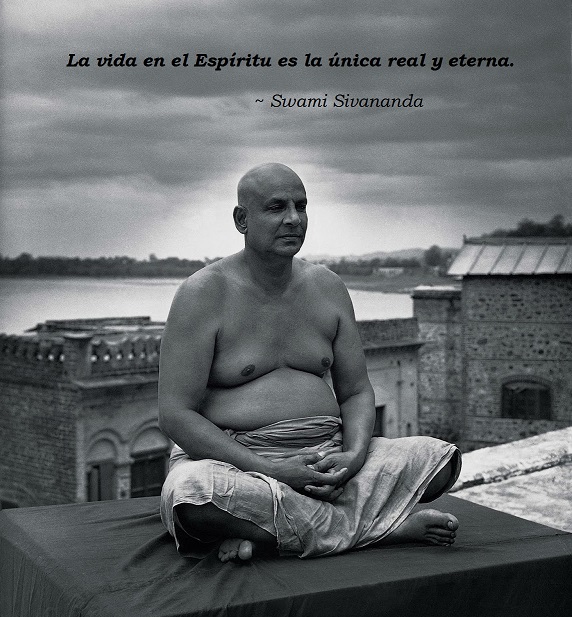
Samadhi according to the Upanishads
by Swami Sivananda
Source: Samadhi Yoga by Swami Sivananda
Samadhi is that state of pure consciousness, the supreme blissful state, free from the triads (the meditator, meditated and meditation). It is the state where the Jivatma becomes one with the Paramatma.
- The Chitta or mind that is steady like the flame of a lamp in a windless place, which has given up the idea of meditator and meditation and which constantly dwells in the Dhyeya Vastu or Brahman, is Samadhi.
- The mind, when it is free from thoughts, desires and motion, merges in the supreme Brahman. (This state is Samadhi).
- When through knowledge of the Self which is seated within one’s heart, he attains Vijnana or direct realisation and when the body-idea is completely eradicated and when peace is attained, in that state the Vrittis, mind and intellect, are destroyed. (This state of destruction of mind is Samadhi).
- Having controlled the Prana and Apana during Kumbhaka with the gaze steadily fixed at the tip of the nose, performing the Shanmukha Mudra with the fingers of the two hands, the mind merges itself in the sound of Pranava or OM.
- After the dribbling of nectar, like the milk from the cow’s udder, the group of senses becomes calm by withdrawal and then results Manonasa (destruction of the mind). (This is Yoga Samadhi).
- When the five organs of knowledge are at rest together with the mind and when the intellect ceases functioning or becomes calm that they (the seers) call the highest state.
- When all Sankalpas (desires) of the mind become calm, when the mind is neither waking nor sleeping, when it is motionless and calm like a stone, the highest Brahmic state of Samadhi is attained.
- When the Prana moves in the middle (the Sushumna, leaving both the Ida and Pingala) the mind becomes steady. Perfect state of tranquillity of the mind is the Brahmic state of Samadhi called Manonmani.
- The Jivanmukta attains Sarupamanonasa which leaves behind a slight trace of ego. But for a Videhamukta there is complete destruction of the ego, sleep and all sins. He attains Arupamanonasa.
- When the Chitta or mind is free from all flickering desires when the mind is destroyed, the peaceful state ensues which is like unto Sushupti or deep sleep while (the Yogi is) awake.
- That state is neither waking nor dreaming on account of the absence of Sankalpas or desires. It is not also Sushupti or sleep because of the absence of inertness there.
- Knowledge of Sattva or Brahman which is like the fire which burns up the grass of Vasanas (desires) is indicated by the word Samadhi and not the state of inertia or mere silence.
- The complete eradication of Vrittis caused by the destruction of thoughts by generating the Brahmakara Vritti or meditation on Brahman is called Samadhi.
- When the currents of Raga-Dvesha attain a feeble state by the knowledge that Brahman is not any of the objects seen or heard of, the steadiness in the knowledge of Brahman is strengthened by the practice of knowledge and dispassion and this state (Nishtha) is known as Samadhi.
- “I am the Supreme Brahman; I am Brahman alone,” when this one thought remains to the exclusion of all other thoughts, it is called Samadhi.
- The rising of the knowledge of the identity of Jivatman and Paramatman and the complete forgetfulness of meditation (Triputi) is called Samadhi.
- O wise man! The sages understand Samadhi to be that state of supreme intelligence or pure consciousness attained by the self-controlled, satiated Chitta, which points out the way to the knowledge of Brahman.
- The state of the mind which is devoid of changing thoughts, free from egoism and which does not follow the course of the pairs of opposites heat and cold, pleasure and pain etc., is Samadhi. The steady position of the Merudanda (spine) is also indicated by Samadhi.
- The state of steadiness of the mind, free from all craving for sensual enjoyment, free from the ideas of sensual enjoyment, free from the ideas of acquiring and giving up, that state of fullness of the mind is called Samadhi.
- The merging of the mind into the Atman like salt put in water is called Samadhi.
- Destruction of all Sankalpas and knowledge of the sameness of Jiva and Brahman without the least difference is called Samadhi.
- Devoid of Vrittis, devoid of mind and intellect, devoid of decay, devoid of all changes, is the state of Samadhi.
- The steady flow of Brahmakara Vritti, devoid of egoism which asserts “I am this body. I am the mind, etc.,” caused by the practice of meditation is called Samprajnata Samadhi.
- The Samadhi wherein there is destruction of Vasanas or Vrittis of the mind and which brings face to face the enjoyment of the Supreme blissful state is termed Asamprajnata Samadhi–dear to the Yogins!
- Leaving aside all the objects, consisting of names and forms by the direct realisation of the bliss of the Atman, the mind becomes steady like a flame in a windless place. This is Nirvikalpa Samadhi.
- The light of consciousness lighted up by the steady flow of Antarmukha Vritti (fixing the mind on the Atman) is the Samadhi practised by sages wherein all desires drop away by themselves.
- Samadhi is that real state of direct realisation of the supreme Self which is all auspiciousness which is all-full, all-pervading and fills the above, below and the intervening spaces.
Thus end the indicative verses on Samadhi.
The ‘secret’ to a plentiful life, a life of harmony, happiness and contentment is to have a sattvic mind free from desires and ego and to live in every moment in conscious contact with our true Self (Consciousness).
🌺 Peace, Love, Harmony
 atmannityanada